
Structuring a Small Mining Operation Around Real Margins
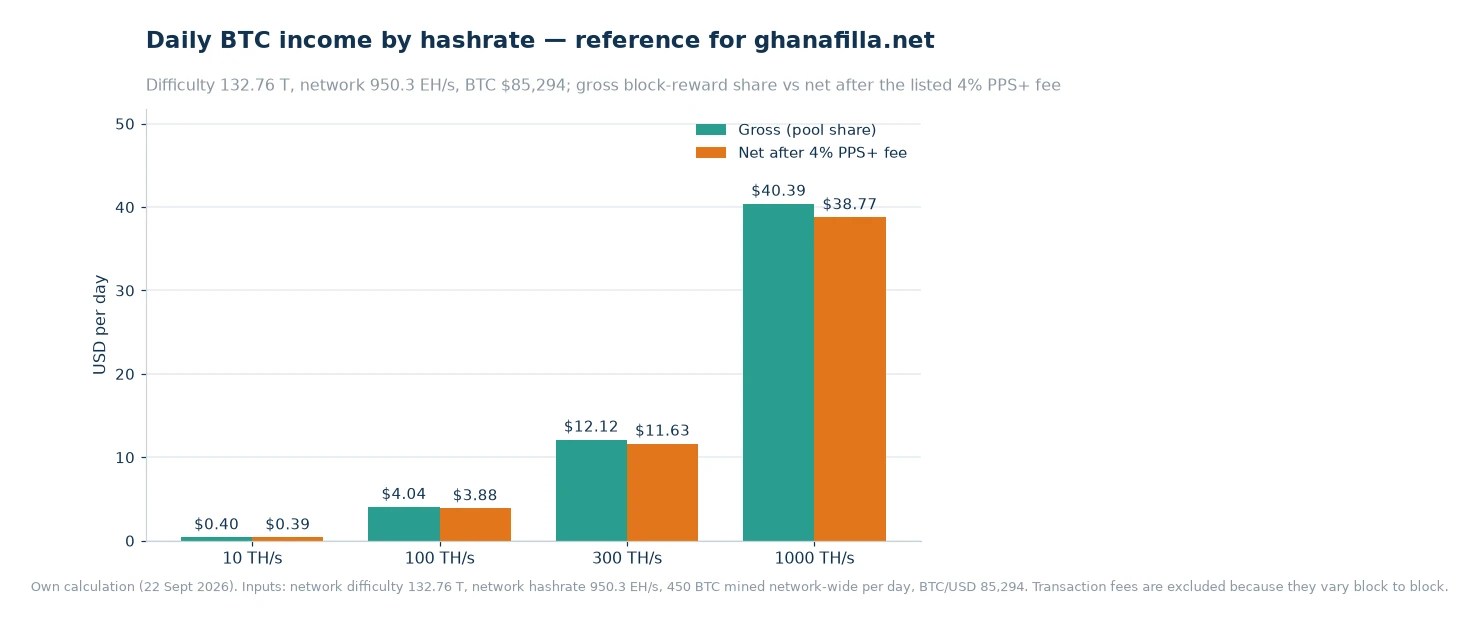
A 300 TH/s operation earns about $12.12 a day gross and $11.63 after the listed 4% PPS+ block-reward fee, which is $348.90 a month — while its power draw of 4,320 kWh costs $259.20 at $0.06/kWh, leaving roughly $89.70. Revenue decides what you buy; margin decides whether the operation survives the next difficulty adjustment.

Key takeaways
- 300 TH/s produces about 0.00014206 BTC a day, $12.12 gross and $11.63 net of the listed 4% PPS+ block-reward fee, or $348.90 across 30 days.
- Power at 20 joules per terahash is 0.48 kWh per TH/s per day, so 300 TH/s consumes 4,320 kWh a month and 1 PH/s consumes 14,400 kWh.
- At $0.06/kWh the 300 TH/s unit keeps about $89.70 a month; at $0.08/kWh the same unit keeps about $3.30, which is why power price is a structural decision.
- Breakeven is $0.0841/kWh gross and $0.0808/kWh after the listed fee at 20 J/TH — and $0.1077/kWh net at 15 J/TH, where the machine draws less.
Revenue is not the number to structure around
Mining arithmetic produces two numbers and only the second one is yours to keep. At difficulty 132.76 T, one terahash earns 0.0000004735 BTC a day; at a BTC price of $85,294 that is $0.0404 gross and roughly $0.0388 after the listed 4% fee on the PPS-settled block reward. Multiply by your fleet and you have revenue. Subtract the power bill and you have margin, which is the figure that has to survive a difficulty increase, a price dip and a bad month of uptime.
The gap between the two is wider than beginners expect. A 300 TH/s unit grosses $363.60 across 30 days and nets $348.90 after the listed fee, but only keeps $89.70 of that once power is paid at $0.06/kWh. A 1 PH/s operation nets about $1,163.10 a month before power and $299.10 after it at the same tariff. Roughly three quarters of the revenue line is a power bill with your name on it.
That ratio is why structure beats shopping. A machine that is 5% faster changes revenue by a few percent; moving from $0.08/kWh to $0.04/kWh changes the margin of the 300 TH/s unit from $3.30 a month to $176.10, which is the difference between a hobby and a business.
The power price sets the size of the operation
Power consumption is the input you choose, and it is simple to state. A miner rated at 20 joules per terahash draws 20 joules per second for every terahash of output, which converts to 0.48 kWh per TH/s per day; at 15 J/TH the same terahash needs 0.36 kWh. Scale that and the monthly figures become the first line of any operating plan.
Nothing else on the cost side moves as much. Difficulty trims revenue by a percent or two every two weeks. Price can move more than that in a day. Electricity is charged monthly at a rate you negotiated once, and it lands whether the machines are producing or not — which is exactly why it belongs in the structure rather than in the ledger after the fact.
| Power price | Power consumed | Monthly power cost | Net revenue after the listed fee | Monthly margin |
|---|---|---|---|---|
| $0.04/kWh | 4,320 kWh | $172.80 | $348.90 | $176.10 |
| $0.06/kWh | 4,320 kWh | $259.20 | $348.90 | $89.70 |
| $0.08/kWh | 4,320 kWh | $345.60 | $348.90 | $3.30 |
| $0.0808/kWh, net breakeven at 20 J/TH | 4,320 kWh | $349.06 | $348.90 | about zero |
Worked example: the same fleet at 1 PH/s
Line one. At 132.76 T a PH/s of SHA-256 produces about 0.00047353 BTC a day, which is $40.39 at $85,294 per BTC.
Line two. Deduct the listed 4% on the PPS-settled block reward and the daily figure becomes $38.77, or about $1,163.10 across 30 days.
Line three. Power at 20 J/TH is 480 kWh a day, so a month consumes 14,400 kWh. At $0.06/kWh that bill is $864.00, leaving about $299.10 of margin.
Line four. Repeat at $0.08/kWh: the bill rises to $1,152.00 and the margin falls to about $11.10 a month — still positive, and no longer enough to fund a replacement fan, let alone a machine.
Line five. The breakeven rate is $0.0841/kWh gross and $0.0808/kWh after the listed fee at 20 J/TH. At 15 J/TH the same 1 PH/s draws 360 kWh a day and breakeven rises to $0.1122 gross and $0.1077 net, which is the clearest argument for efficiency-rated hardware.
Line six. Then budget for stopped time. An hour offline at 1 PH/s is about $1.68 of gross income, so a modest 12 hours of downtime in a month costs roughly $20.20 — small against $299.10 of margin at $0.06/kWh, and enough to matter at $0.08.
Where a small operation should build in flexibility
Three levers keep a small fleet viable when the inputs move against it. The first is tranche sizing: buying 300 TH/s at a time means each addition has to justify its own power draw at the tariff you actually pay, rather than being absorbed into an average that hides an unprofitable rack. The second is revenue shape — pooled hourly settlement at current difficulty under PPS+ pays out in a steady stream, while PPLNS with a listed 2% on both components pays after 6 confirmations across the last 5 difficulty rounds and can leave a small operation short of cash between blocks.
The third is liquidity. When power is due before a payout run is complete, borrowed capital can bridge the gap, and a facility secured against holdings is designed for exactly that — add collateral, request the amount, receive funds, repay, redeem — rather than selling inventory at a bad moment. The Collateral-Pledged Loans page sets out that sequence.
The other structural lever is hardware refresh. The Miner Profitability Ranking compares model earnings at the current difficulty and price, which is the right input for a decision about whether to replace a machine before it drifts below breakeven rather than after. If the plan involves hosted power instead of your own tariff, the ViaBTC Mining Guide is the place to confirm the listed rates and payout settings before committing, since a hosting contract is a multi-year version of the same margin question.
Rules that keep a small fleet alive
- Compute margin per tranche, not per fleet. A 300 TH/s unit at $0.08/kWh leaves about $3.30 a month, and averaging it with a cheap-power unit hides the loss.
- Decide on net, never gross. The listed 4% on the PPS-settled block reward is about $14.70 a month at 300 TH/s, before power is even considered.
- Hold a downtime reserve. At 1 PH/s each offline hour costs about $1.68, and the reserve should scale with the fleet.
- Re-run the breakeven after every adjustment. A 1.9% difficulty increase trims per-terahash output by the same 1.9% while the power bill stays exactly where it was.
- Keep the asset mix deliberate. KAS, LTC with merged mining and other supported networks price differently — LTC at 1 TH/s of Scrypt is about $80.48 a day gross, and KAS runs at roughly $237 per PH/s per day — so a fleet spread across two algorithms has two sets of margins to track.
Frequently asked questions
What margin is realistic for a small mining operation?
It depends almost entirely on power. A 300 TH/s unit at 20 J/TH earns $348.90 a month net of the listed fee and keeps about $176.10 at $0.04/kWh, $89.70 at $0.06/kWh and $3.30 at $0.08/kWh.
Should a small miner use PPS+ or PPLNS?
PPS+ if the power bill arrives monthly and needs matching income, since it settles hourly at current difficulty under a listed 4% fee on the block reward; PPLNS if a lower listed fee on both components is worth less predictable arrivals.
How much hashrate needs a formal operating plan?
Above roughly 300 TH/s, because that unit's power bill passes $250 a month at $0.06/kWh and a single difficulty increase moves the margin by several percent.
Build the plan around the margin line
Start with the power price, then choose the hashrate that clears it with room to spare, then decide the revenue shape that matches the way you actually pay bills. Rebuild the arithmetic after every difficulty adjustment and after any change in tariff, and treat the margin line rather than the revenue line as the number that governs growth. A small fleet that knows its breakeven to three decimal places is in a far stronger position than one that knows its monthly revenue to the dollar.
Data and sources: ViaBTC listed fee schedule[1]. Difficulty (132.76 T), implied network hashrate (950.3 EH/s), 450 BTC issued network-wide per day, the BTC price of $85,294, and the LTC and KAS reference figures were read from public chain data and market feeds on 22 September 2026; read 22 Sept 2026. All figures are arithmetic on those inputs, exclude transaction fees because they vary block by block, and are not a promise of earnings.