
Sharing a Mining Pool Link With Your Group
A group chat is a poor place for a vague recommendation and a good place for a checked one. At 73 TH/s, current conditions produce 3.275e-05 BTC a day, worth $2.77 at $84,692 per BTC, or $2.66 after the listed 4% on the block-reward component. Those are the kind of numbers a group can compare against its own power bills.

Key takeaways
- At 73 TH/s the daily payout is 3.275e-05 BTC, or $2.77 gross and $2.66 net of the listed 4% on the block-reward component.
- At 730 TH/s the same inputs give 0.00032748 BTC a day, $27.74 gross and $26.63 net.
- A referral link records an arrival; the payout formula and listed rates stay the same for everyone who uses it.
- Groups compare daily figures, so share the arithmetic before the link.
A group link is a recommendation, not a coupon
When a link is posted in a group, the people reading it assume the poster has some reason to trust the destination. That assumption is the whole value of the post and the whole risk of it. A coupon can be forwarded without judgment; a mining recommendation cannot, because the reader will run hardware against it and may keep running for months.
The safer framing is to treat the post as a short review with a disclosure. Say what the pool does, how the payout settles, what the listed rates are, and that the link is a referral. Then let the reader check the numbers. A group that mines together will ask about fees and payout timing anyway, so answering those questions up front saves the thread from turning into a argument about claims nobody can verify.
What the program page settles
The ViaBTC Referral page is where the terms of the program are stated, including how a referral is tracked and what eligibility applies. Read it before posting rather than after someone asks. The page is the authority on the program; the group post should not add numbers that are not there.
What the link does not do is change the mining. The network hashrate, the block subsidy and the listed pool rates are the same for a referred account as for any other. A group member who joins through the link still gets the same choice between PPS+ and PPLNS, and still sees the same daily output for a given hashrate. Keeping that clear prevents the link from looking like a secret upgrade.
Three rig sizes in a small group
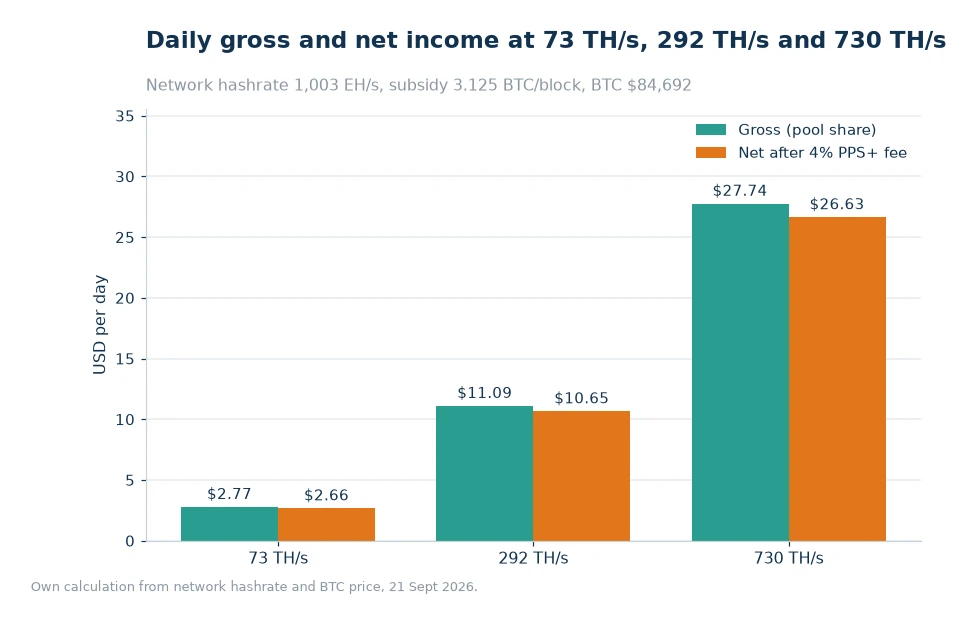
Groups usually contain a mix of one-machine miners and small racks. The rows below give each member a reference point. The network inputs are held constant, so the differences come only from the machine count. The net column applies the listed 4% to the block-reward component and excludes power, which each member supplies at their own rate.
| Hashrate | BTC per day | Gross USD per day | Net USD per day |
|---|---|---|---|
| 73 TH/s | 0.00003275 | $2.77 | $2.66 |
| 292 TH/s | 0.00013101 | $11.09 | $10.65 |
| 730 TH/s | 0.00032748 | $27.74 | $26.63 |
The middle row is four times the first, and the top row is ten times the first. That makes the table easy to audit in a group: a member with four machines can check whether their payout is close to four times the single-machine figure. If it is not, the conversation turns to power, cooling or hardware rather than to the pool rate, which is usually the more useful conversation.
Sharing with people who do not mine yet
Some group members will be curious rather than active. For them, the link is the least important part of the post. The useful part is the explanation that mining output depends on network hashrate as well as on their own machine, and that the dollar value depends on a price nobody controls. A short worked example does more than a list of features, because it shows the reader how to check any claim for themselves.
It also sets expectations. A reader who sees that 73 TH/s produces 3.275e-05 BTC a day understands that the figure is small and variable. That is a better first impression than a headline number that turns out to assume a different price, a different difficulty or a different hashrate. The group post should leave the reader with a method, not a promise.
Keeping the group informed
The most useful follow-up is a short note when the inputs change. Difficulty adjusts roughly every two weeks, and the next estimate is minus 2.12%. A one-line update that the daily figure has moved, with the new arithmetic, keeps the group's expectations aligned with reality. It also gives the poster a reason to be in the thread that is not another request to click.
Payout method is the other recurring topic. PPS+ settles hourly against current difficulty, which suits members who want a steady balance. PPLNS settles after 6 confirmations and shares the last 5 difficulty rounds, which suits members who can tolerate a lumpier arrival pattern in exchange for a listed 2% on both components combined. Explaining that trade once saves a dozen repeated questions.
Worked example
Take 73 TH/s and run the chart arithmetic with the inputs read on 21 Sept 2026.
- Daily BTC per TH/s is 450 divided by 1,003,000,000, which equals 4.4865e-07.
- Multiply by 73: 4.4865e-07 times 73 equals 3.2752e-05 BTC, shown as 3.275e-05.
- Multiply by the BTC price: 3.2752e-05 times $84,692 equals $2.77 gross.
- Apply the listed 4% to the block-reward component: 4% of $2.77 is $0.11, leaving $2.66 net.
- Multiply by four for 292 TH/s: 0.00013101 BTC, $11.09 gross and $10.65 net.
- Multiply by ten for 730 TH/s: 0.00032748 BTC, $27.74 gross and $26.63 net.
- Thirty days at 730 TH/s nets about $798.90 before power, a figure a small group can compare with its combined electricity bill.
Give the group a page to check
A link to the pool state page is a useful companion to a referral post, because it lets members see the pool's hashrate and block-finding record for themselves. Numbers on a live page settle more arguments than a screenshot, and they give the group a shared reference when someone asks whether a quiet day is normal.
Post the arithmetic, post the disclosure, and post the link once. Then answer questions with the same figures. A group that understands the formula will use the link if it suits them and ignore it if it does not, which is exactly what a recommendation should allow.
Frequently asked questions
Should I post a referral link in a group I do not run?
Ask the group's moderator first and disclose that it is a referral. A mining group usually tolerates a link that comes with useful arithmetic, but it rarely tolerates repeated posting without permission.
Does the referred account get the same payout rates?
Yes. The listed rates apply to the payout regardless of how the account arrived, so PPS+ and PPLNS work the same way and the daily output for a given hashrate is unchanged.
What should I include in the post besides the link?
The payout method, the listed rates, a daily figure at a common hashrate and a disclosure. A reader who can check 3.275e-05 BTC a day at 73 TH/s has enough to judge the rest.
Post the method, then the link
Start with the daily figure at a hashrate the group recognises, show the listed charge and name the link as a referral. At 73 TH/s the gross is $2.77 a day and the net is $2.66, which is a small enough number to check on a phone. A group that can check the number is a group that can decide for itself.
Sources: the ViaBTC referral page for the program terms and the pool fee schedule for the listed 4% and 2% rates. Network hashrate 1,003 EH/s, difficulty 132.76 T, subsidy 3.125 BTC per block, 450 BTC daily and BTC $84,692 were read 21 Sept 2026, published 22 Oct 2026[1]. Every dollar figure is arithmetic on those inputs and moves when they move.